The previous article established the diagnosis. Ninety-nine listed banks, a population shrinking by 900,000 a year, deposit growth at a crawl, non-interest income effectively negative after stripping out equity sales. The patient is stable but deteriorating. This article is about who is reaching for the scalpel.
The regulatory starting gun
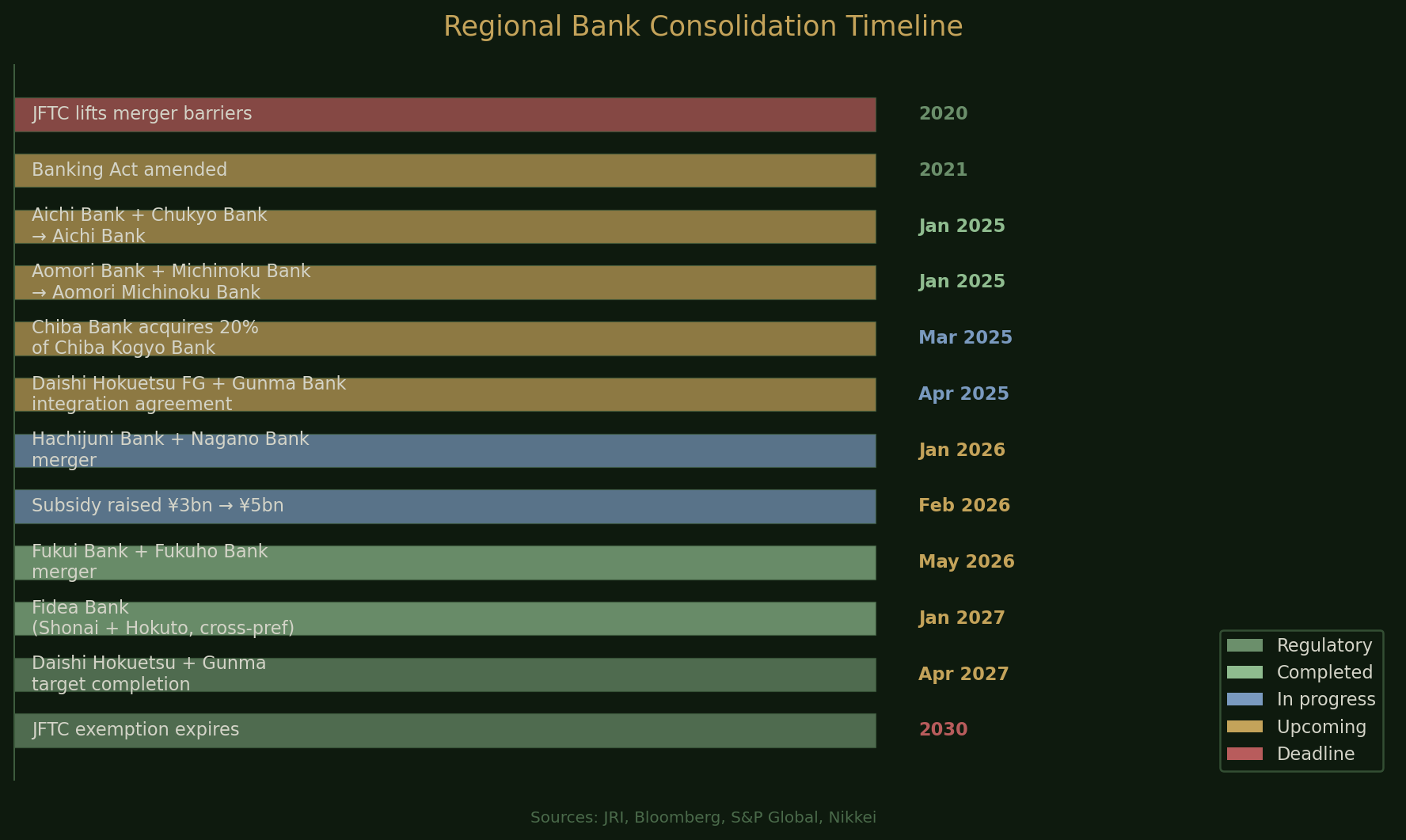
In 2020, the Japan Fair Trade Commission lifted the antimonopoly barriers to same-prefecture bank mergers. The exemption runs for ten years. The clock expires in 2030.
A year later, lawmakers amended the Banking Act to make the mechanics easier still. The FSA began telling bank presidents, publicly, that consolidation should be “a major option” for navigating demographic decline.
Then, on February 27, 2026, the government approved a revision to the Financial Function Enhancement Act, raising the merger subsidy ceiling from 3 billion yen to 5 billion per deal and adding a new subsidy for system integration costs. Finance Minister Satsuki Katayama, who also serves as Minister for Financial Services, explained the move as creating an environment for regional banks to fulfil their role in local economies.
Katayama’s biography makes the appointment resonant. She joined the Finance Ministry in 1982 and worked on rescue plans for failing banks during the 1990s crisis. Three decades later, she is overseeing the same sector from the same ministry. The difference is that the 1990s crisis was caused by bad debts. This one is caused by demographics, which no bailout fund can reverse.
In December, she put it bluntly: if local financial institutions fail to support their regions with lending, rural areas “will have no future”.
Five layers of incentive
The government is not merely permitting consolidation. It is paying for it, across multiple channels simultaneously.
First, the merger subsidy ceiling was raised from 3 billion to 5 billion yen per deal in the February 2026 law revision. Second, the same revision created a new subsidy specifically for system integration costs, typically the most expensive element of any bank merger.
Third, the Bank of Japan itself entered the game in 2020 with a programme offering an additional 0.1% interest on current account deposits held at the central bank by regional banks that underwent reorganisation or M&A.
Fourth, the JFTC’s antimonopoly exemption eliminates the regulatory cost of same-prefecture mergers. No protracted competition review, no legal fees to fight an objection. This is a regulatory subsidy in all but name.
Fifth, the accounting treatment of below-book acquisitions creates a structural incentive. Negative goodwill — the gap between net assets and purchase price — books as a day-one gain and carries favourable tax implications.
Government cash, central bank incentives, regulatory clearance, system subsidies, and accounting windfalls. Five forces, all pushing in the same direction. It is difficult to recall another instance in which Japanese policymakers have aligned this many levers behind a single sectoral outcome.
The deal pipeline
For years after the JFTC opened the window, remarkably little happened. That has changed.
Aomori Bank and Michinoku Bank merged in January 2025, forming the first same-prefecture combination of two major regional banks. The new Aomori Michinoku Bank controls roughly 80% of local lending in a prefecture whose population fell 1.72% last year. In the same month, Aichi Bank and Chukyo Bank merged to form “Aichi Bank”.
The pipeline now stretches into 2027. Hachijuni Bank and Nagano Bank will merge in January 2026. Fukui Bank and Fukuho Bank follow in May 2026. Shonai Bank (Yamagata) and Hokuto Bank (Akita) will combine as “Fidea Bank” in January 2027, a cross-prefecture deal. Daishi Hokuetsu Financial Group and Gunma Bank signed a basic agreement targeting integration by April 2027.
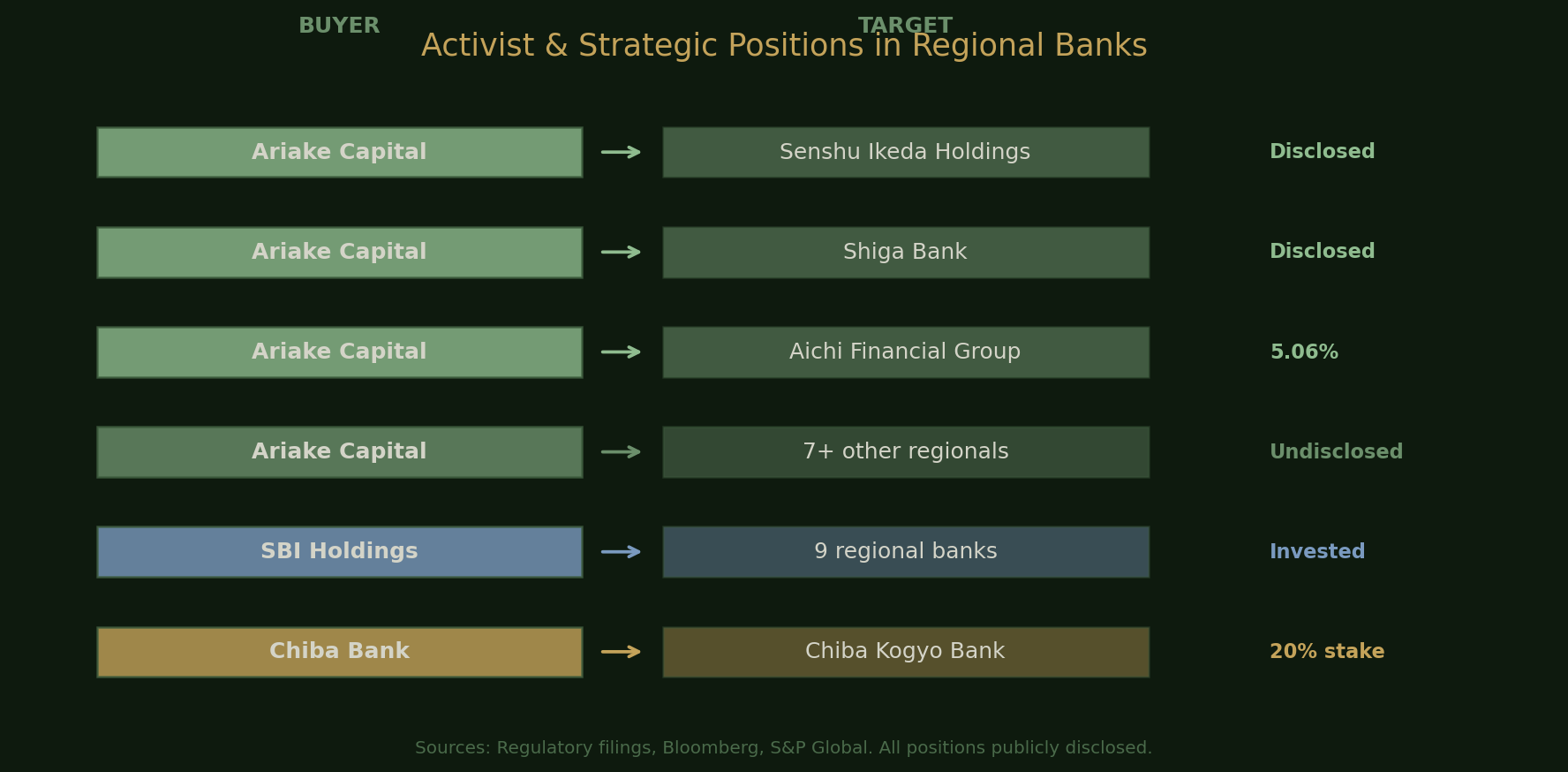
In Chiba, Chiba Bank acquired a 20% stake in local rival Chiba Kogyo Bank and the two are forming a holding company. In central Japan, Shizuoka Bank, Yamanashi Chuo Bank, and Hachijuni Bank entered a comprehensive business alliance expected to lead to capital ties.
SBI Securities analyst Toyoki Sameshima has a succinct assessment: “I don’t think there’s a single regional bank president who isn’t thinking about consolidation.”
The activists
Regulators are pushing. But private capital is pulling.
Ariake Capital, a hedge fund run by Katsunori Tanaka, a former Goldman Sachs analyst, has disclosed positions in more than ten regional banks. Regulatory filings confirm stakes in Senshu Ikeda Holdings, Shiga Bank, and Aichi Financial Group, the last of which was itself formed from a 2022 merger. Aichi Financial sits in Nagoya, Toyota’s home prefecture, where speculation of further consolidation has simmered for years. Ariake disclosed a 5.06% stake in October 2024.
Tanaka has described 20 trillion yen in assets as the “threshold for survival” for regional banks.
SBI Holdings’ CEO Yoshitaka Kitao is less circumspect. “We’re planning to put regional banks into our group,” he has said, having already invested in nine banks.
Most strikingly, the FSA itself is watching Ariake’s moves approvingly, telling regional bank executives they “should engage in constructive dialogue” with such investors. When the regulator welcomes the activist, the direction of travel is clear.
No precedent
History offers partial analogies, none exact.
America’s community banks peaked at about 14,500 in 1984 and have fallen to roughly 4,500. The consolidation was driven by deregulation and economies of scale. But the US added a hundred million people over the same period. Banks disappeared because regulation changed, not because customers did.
Spain’s 45 regional savings banks, the cajas, were compressed into 18 entities between 2009 and 2013, all converting from mutual to commercial banks. The trigger was a property bubble. The cautionary tale is Bankia, created in 2010 from seven failing cajas and nationalised two years later at a cost of 19 billion euros. Merging weak banks produced a larger weak bank.
Japan’s regional banks face regulatory change, real estate risk, and demographic decline simultaneously. The first two have precedents. The third does not. No major economy has attempted to consolidate its banking sector while the customer base is permanently and irreversibly shrinking. The United States halved its banks over forty years while adding a hundred million people. Japan is trying to do the same while losing them.
The clock
Wellington Management makes the point that with the JFTC’s exemption window set to close in 2030, and with two major deals recently announced including one involving a bank that had not merged since 1945, “no one wants to be left behind while their peers move ahead with strategic partnerships.”
The question for investors is not whether consolidation will happen. It is happening. The question is which banks are acquirers and which are targets, and what separates them.
A bank trading at 0.3 times book is either a value trap or a deposit franchise priced for disposal. The difference depends entirely on whether a buyer is coming. The next article will examine the numbers that distinguish one from the other.
This article reflects my own reading of publicly available information and is not investment advice.