This is Part 1 of a two-part series on the next phase of Japan’s corporate governance revolution. Part 2 covers the consequences: the delisting wave, the 2026 AGM season, and where to look.
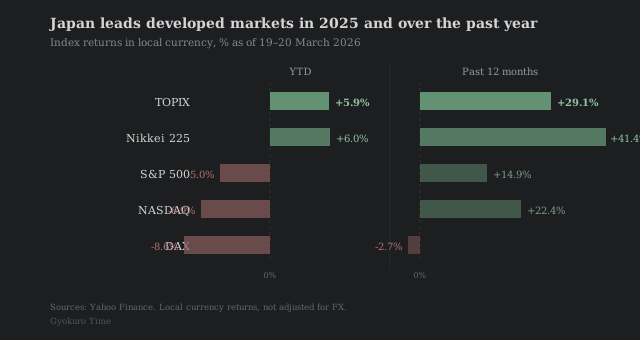
Japanese equities are outperforming every major developed market in 2026. TOPIX is up 29% over the past year while the S&P 500 has returned 15% and the DAX has gone negative. The YTD gap is wider still. With the BOJ hiking while the Fed holds, local currency returns understate the divergence for dollar-based investors.
Last month, this blog published an overview of Japan’s PBR reform — the Tokyo Stock Exchange’s 2023 directive urging listed companies to improve capital efficiency and stock valuations. That article described the architecture: the Stewardship Code, the Corporate Governance Code, the TSE’s comply-or-explain list, the buyback boom, the cross-holding unwind. It was a map of what had been built.
This series covers what comes next. The regulatory apparatus has shifted from urging change to demanding evidence of it. The instrument is the Corporate Governance Code revision — the first in five years — which the Financial Services Agency aims to finalise by mid-2026. At stake is ¥126 trillion ($840bn) in cash sitting on Japanese corporate balance sheets.
What happened on February 26
The FSA’s Expert Panel on the Revision of the Corporate Governance Code convened its second meeting on February 26, 2026. The first meeting was held on October 21, 2025. The panel’s mandate is to produce draft revisions for public comment, with a target of finalisation by June 2026 — the month the original Code took effect (2015) and both subsequent revisions (2018, 2021) were published.
The draft rules presented at the February meeting centre on a single principle: companies must demonstrate that they are allocating resources effectively, with specific attention to whether cash is being deployed for investment or merely hoarded. The language is careful — the Code is not law — but the direction is unmistakable. The FSA is moving from asking companies to think about capital efficiency to asking them to prove it.
Three elements of the draft deserve attention.
1. Cash verification
The headline provision requires companies to verify that they are using cash effectively — a more consequential shift than the bland language suggests. Under the current Code, companies are asked to “be conscious of the cost of capital and stock price” — the language of the TSE’s 2023 directive. Many responded by publishing plans. Some were genuine. Many were boilerplate: a paragraph in the annual report acknowledging the directive, with no measurable commitment.
The draft revision shifts from awareness to accountability. Companies would need to demonstrate, not merely state, that their allocation of resources — including cash holdings — serves a strategic purpose. This changes the burden. Under the current framework, a company sitting on ¥500 billion in cash can comply by saying it is “considering” how to deploy it. Under the draft, that company would need to explain what purpose the cash serves and why it is not being returned to shareholders or invested.
McKinsey estimated that Japanese nonfinancial companies hold over ¥150 trillion ($1 trillion) in cash — the figure varies depending on which entities are counted. Bloomberg put the listed-company figure at ¥126 trillion ($840bn).
2. Cross-shareholding transparency
The draft addresses cross-shareholdings directly, requiring enhanced disclosure of the purpose and rationale for holding strategic stakes in other companies. This is not new in principle — the 2021 revision already pushed in this direction. But the draft tightens the expectation by asking companies to disclose ultimate beneficial ownership and to explain why each holding is in shareholders’ interests.
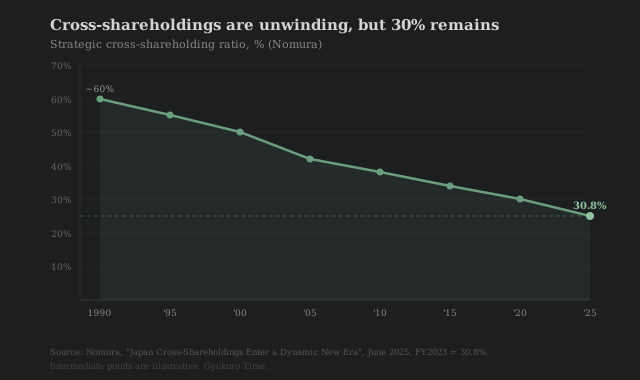
Why now? According to Nomura, cross-shareholdings now account for roughly 25% of TSE market capitalisation, down from approximately 60% in 1990. The three largest insurance groups — MS&AD, Tokio Marine, and Sompo — have committed to selling their cross-held stakes entirely. The megabanks are on a similar trajectory. But many mid-cap industrials and regional companies have barely begun. The Code revision turns the spotlight from the leaders — who have already moved — to the laggards.
When a company sells its cross-held stake, the proceeds frequently flow into buybacks, creating the virtuous cycle that has powered the market since 2023: the seller improves its own capital efficiency; the company whose shares were sold often responds with its own buyback to absorb supply; both companies’ ROE improves. The Code revision accelerates this cycle by raising the reputational cost of holding on.
3. Collaborative engagement
A quieter but significant change concerns investor engagement. The revised Stewardship Code, finalised in June 2025, already encouraged collaborative engagement — multiple institutional investors approaching a company together. The barrier had been Japan’s large shareholding reporting rules, which treated coordinated investors as “joint holders” and triggered onerous disclosure requirements.
The 2024 amendments to the Financial Instruments and Exchange Act, taking effect on May 1, 2026, introduce a “Collaborative Engagement Exemption.” If the agreement between investors meets three criteria — all parties are institutional investors, the purpose is not to make a material proposal, and the agreement applies only to individual voting decisions — the investors are not treated as joint holders. This removes the legal friction that previously made it risky for, say, three life insurers or two foreign asset managers to coordinate their engagement with a cash-hoarding mid-cap.
The practical effect: collaborative pressure on sub-1.0 PBR companies becomes legally safer. The 2026 AGM season, which falls immediately after the Code revision, will be the first test.
What the Code is not
Expectations can run ahead of reality, so it helps to be specific about what the Code does not do.
The Code is not law. It carries no statutory penalty. It operates through comply-or-explain: a company can decline to comply with any principle, provided it explains why. The power of the Code lies not in enforcement but in visibility — the TSE publishes which companies have disclosed capital efficiency plans and which have not. In a corporate culture where public standing matters, the reputational mechanism is more potent than many foreign investors appreciate, but it is not a mandate.
The Code also does not prescribe specific actions. It will not tell a company to buy back ¥100 billion in shares or cut its cash ratio to 5%. It creates the framework within which boards make those decisions under the pressure of investor expectations, peer behaviour, and the increasingly hostile AGM environment. The compulsion comes from the ecosystem, not the text.
Why June matters
The original Code took effect in June 2015. It was revised in June 2018 and again in June 2021. Each iteration catalysed a measurable shift in corporate behaviour. The 2015 Code introduced independent director requirements. The 2018 revision strengthened board diversity expectations. The 2021 revision added the Prime Market governance overlay that led directly to the TSE’s 2023 PBR directive.
The June 2026 revision arrives into a market that has already moved further than any prior starting point — record buybacks, record activist proposals, record delistings. Whether the Code revision sustains momentum or is already priced in depends on where you look. For the leaders — MUFG, Toyota, Sony, Hitachi — the Code revision confirms what they are already doing. For the ¥126 trillion in corporate cash, most of which sits on the balance sheets of mid-cap industrials, regional conglomerates, and companies that have published boilerplate capital efficiency plans with no measurable follow-through, the revision raises the cost of inaction.
Part 2 examines the consequences: the ~500 TOPIX ejections coming by 2028, the 2026 AGM battlefield, and where the pressure concentrates.
The architecture was built between 2014 and 2023. The TSE turned it on in March 2023. The FSA is raising the bar again. For patient investors in Japan, the next phase is where the compounding begins.
This article reflects my own reading of publicly available information and is not investment advice.
— Gyokuro