This is Part 2 of a two-part series. Part 1 covered the June 2026 Code revision and the ¥126 trillion ($840bn) cash question.
Part 1 described the revised Corporate Governance Code — what it asks companies to prove. This article covers what happens to those that do not comply.
There are two sources of pressure. The first is structural: a multi-year reconstitution of the TOPIX index that will eject roughly 500 companies by July 2028. The second is behavioural: an activist and institutional investor community that submitted a record 399 shareholder proposals in the 2025 AGM season and is preparing for a 2026 season that falls immediately after the Code revision.
Together, they create a pincer. Companies that ignore the Code face reputational pressure from the comply-or-explain regime. Companies that ignore the index face mechanical selling from the large-scale passive funds tracking TOPIX. Companies that ignore both face contested board elections.
The TOPIX reconstitution
The TOPIX is not the Nikkei 225. It is the broad market benchmark — historically, every domestic common stock listed on the old TSE First Section was automatically a constituent. At its peak, the index held over 2,200 names. The result was a diluted, unselective index that included hundreds of companies too small, too illiquid, or too poorly governed to justify institutional ownership.
The reform is being executed in two phases.
Phase 1 ran from 2022 to January 2025. Companies with a free-float adjusted market capitalisation below ¥10 billion ($67m) had their index weightings gradually reduced to zero. This cut the constituent count from over 2,200 to approximately 1,700. The impact on the index’s aggregate characteristics was modest — the removed names were too small to move the needle — but the signal was not. For the first time, TOPIX membership was conditional rather than automatic.
Phase 2 begins in October 2026 and runs through July 2028. This is where the reconstitution becomes consequential. The selection criteria shift to free-float adjusted market capitalisation and annual traded value ratio. All TSE markets — Prime, Standard, and Growth — become eligible, but the bar is higher. JPX Market Innovation & Research estimates the constituent count will fall to approximately 1,200.
The mechanics matter. Companies excluded in the first periodic replacement (base date: last business day of August 2026) will have their weightings reduced in eight quarterly stages from October 2026 through July 2028, via a transition factor declining from 100% to 0% in 12.5% increments. This is not a cliff — it is a slow bleed. Passive funds tracking TOPIX will mechanically sell these names over two years.
For a company on the borderline, the incentive is clear: increase free-float shares (by unwinding cross-holdings or persuading major shareholders to sell), improve liquidity, or watch as passive funds tracking TOPIX methodically exit the stock. Daiwa Institute of Research expects companies near the cut-off to accelerate cross-holding disposals and shareholder return programmes specifically to stay in the index.
The delisting pipeline
Separate from the TOPIX reconstitution — but reinforcing the same pressure — the TSE’s transitional measures for continued listing criteria expired in March 2025. Under the old regime, companies that fell short of the heightened post-2022 listing standards were given grace periods and improvement plans. That grace is now over.
The timeline for a non-compliant company is stark. If a company fails to meet the continued listing criteria at its fiscal year-end record date, it enters a one-year improvement period (six months for trading volume standards). If it still fails at the end of that period, its shares are designated as “Securities Under Supervision,” then “Securities to Be Delisted,” and then delisted — generally within six months of the supervision designation. No alternative trading venue has been established for delisted shares.
The TSE delisted 94 companies in 2024 — the first-ever net decrease in total listed companies. In 2025 the pace accelerated: TSE CEO Hiromi Yamaji told Bloomberg that 125 companies delisted, with 16 more already announced for 2026. Companies whose improvement plans extend past the first record date falling on or after March 1, 2026, are now marked on the TSE’s public watchlist and face supervision designation if they don’t meet criteria by plan-end.
The combined effect of the TOPIX reconstitution and the delisting regime is a market that is actively shrinking and curating itself for quality. The names being removed are precisely the ones that dragged aggregate ROE down and diluted capital returns. A smaller, higher-quality TOPIX benefits everyone still in it.
The AGM battlefield
The second stick is human, not mechanical.
During the June 2025 AGM season, shareholders submitted 399 proposals to 114 companies — the fourth consecutive year of record-breaking numbers. Among these, 146 proposals came from institutional investors including activists. The character of the proposals is shifting. Balance-sheet demands — higher dividends, special buybacks — remain common, but governance proposals are gaining ground: board composition changes, director appointments, and calls for delisting or withdrawal from unprofitable businesses.
Three cases from the past two seasons illustrate the sharpening edge.
Taiyo Holdings. Oasis Management proposed dismissing the sitting president. DIC Corporation — Taiyo’s largest shareholder and strategic partner — publicly declared it would vote against the president’s reappointment before the AGM. It is highly unusual for a business partner to break ranks this publicly. The reappointment received only 46.09% support and was rejected. Oasis’s dismissal proposal received 49.90%. A sitting president removed by shareholder vote, with the company’s own largest holder voting against him.
Daidoh Limited. Strategic Capital, a Japanese activist fund, successfully elected three board nominees with support above 50% at a company that had posted operating losses for eleven consecutive years. After the new board was seated, Daidoh announced plans to increase dividends and repurchase treasury stock. The activist didn’t just win the vote — the vote changed the company.
FMH (Fuji Media Holdings). Management proposed abolishing the sodanyaku advisory position — a legacy governance structure that allowed retired executives to retain influence without accountability. Shareholders approved. Two days later, FMH disclosed that the former president had been reappointed to a newly created “advisor” role with compensation. The sodanyaku title was removed. The substance was preserved. Glass Lewis questioned whether FMH’s reforms represented genuine change or a rebranding of entrenched practices.
The pattern across all three cases: activists are no longer fringe actors submitting proposals that management ignores. Institutional shareholders — including Japanese domestic institutions — are voting with activists against management. The social licence to resist has narrowed.
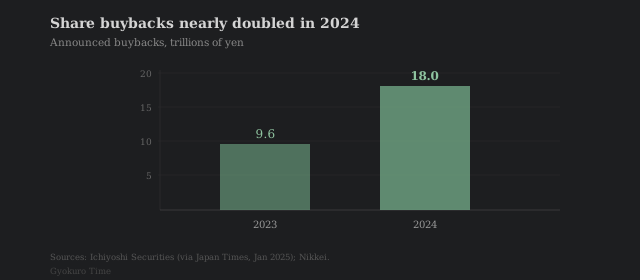
Share buybacks have accelerated in parallel. According to Ichiyoshi Securities, announced buybacks nearly doubled from ¥9.6 trillion in 2023 to ¥18.0 trillion in 2024. Ichiyoshi projects the figure will exceed ¥20 trillion in 2025.
The FT’s problem
In January 2026, the Financial Times ran a headline that captures the current phase: “Japan’s activists grapple with a new problem — success.”
The observation is precise. When activism was culturally taboo, the challenge was getting anyone to listen. Now that institutional investors routinely support activist proposals, that management teams engage constructively, and that shareholder votes actually remove executives, the challenge has shifted. Activism works in Japan. What matters now is what happens to the companies — and the market — as a result.
So far, the result is acceleration. Activist pressure leads to buybacks and cross-holding disposals. Disposals increase free-float, which improves TOPIX eligibility. Buybacks shrink equity, which raises ROE. Higher ROE attracts foreign institutional capital. Foreign capital raises governance expectations further. The cycle compounds.
What the June 2026 proxy season will test
The 2026 AGM season — concentrated in late June, as is standard for March fiscal year-end companies — will be the first proxy season under the revised Corporate Governance Code and the first since the Collaborative Engagement Exemption took effect on May 1, 2026. Both changes lower the barrier to coordinated pressure.
Companies that published boilerplate capital efficiency plans in 2023 and 2024 but have not delivered measurable results will face a harder audience. The Code now asks them to prove cash is deployed effectively. The Stewardship Code asks investors to hold them accountable. The legal framework permits investors to coordinate without triggering joint-holder disclosure. And the TOPIX reconstitution, whose first selection uses August 2026 data, creates a hard deadline for companies on the borderline.
The June 2026 AGM season is where the institutional architecture — built over a decade, from the 2014 Stewardship Code through the 2023 TSE directive to the 2026 Code revision — either delivers or disappoints. The record suggests it will deliver. Four consecutive years of record shareholder proposals, a sitting president removed by shareholder vote, and projected annual buybacks exceeding ¥20 trillion do not describe a market where reform is stalling.
Where the pressure concentrates
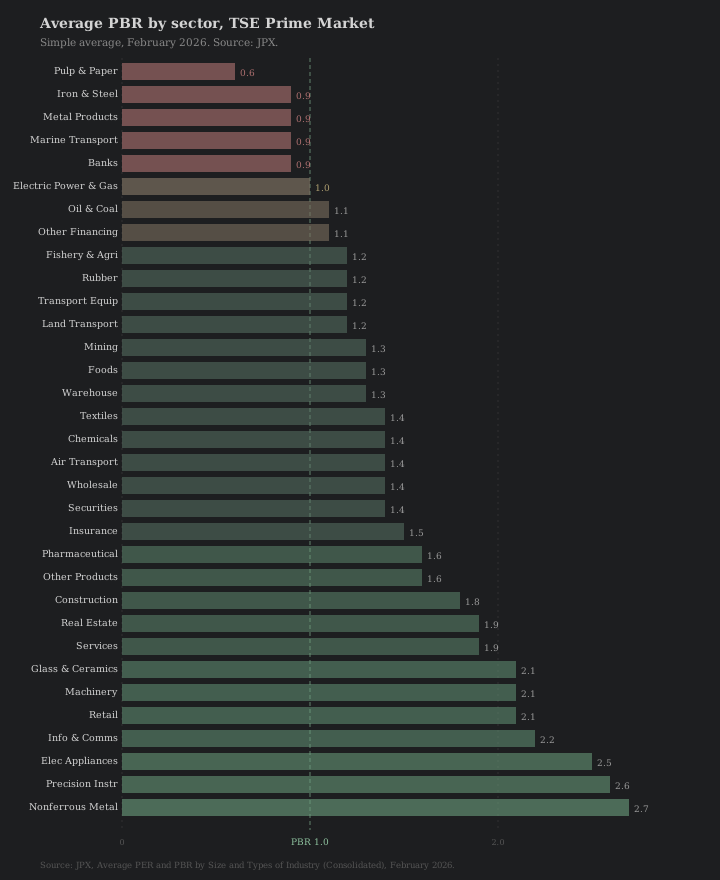
As of March 2026, around 35% of TOPIX constituents trade below book value, based on quarterly securities reports and market prices. JPX’s own sector-level data for February 2026 shows that five Prime Market sectors — including banks, steel, and metals — have an average PBR below 1.0.
The proportion rises sharply by company size. Among the largest TOPIX constituents (Core30), virtually all trade above book. Among the smallest (Small 2), close to half do not. The governance reforms described in Part 1 and in this article are aimed squarely at that long tail.
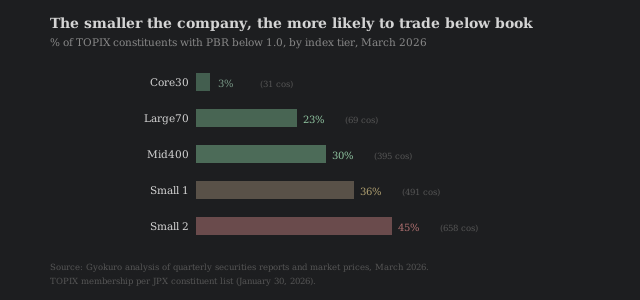
The sectors where sub-book valuations are most concentrated include banks (where roughly three-quarters of TOPIX-listed banks trade below book), steel, utilities, metals, and transport equipment. Mid-cap industrials — chemicals, machinery, auto parts — account for the largest absolute number of sub-book companies.
For readers who want to screen for themselves: any major financial data service — Bloomberg, Reuters, TradingView, Yahoo Finance, or Japan’s own Kabutan — will filter by PBR. ROIC, which separates the cheap-for-a-reason from the cheap-and-shouldn’t-be, requires more work: calculate it as operating profit (tax-adjusted) divided by invested capital, using the quarterly tanshin. JPX publishes TOPIX constituent lists and free-float data monthly.
One warning: stock splits — including a large wave in late 2024 and early 2025 — have broken many PBR calculations in public data sources. Adjusted prices divided by unadjusted book values produce nonsense. Always verify against the latest quarterly securities report.
This blog will not name individual stocks. It has opinions, a kettle, and a Japan equity obsession — but not a compliance department. The screens are obvious and anyone can run them. The edge is qualitative: understanding which companies are likely to change, which activists are circling, and which improvement plans have deadlines that management cannot ignore.
Gyokuro is a tea that rewards patience — the second and third infusions carry as much flavour as the first. Brew the next cup at 70–80°C.
This article reflects my own reading of publicly available information and is not investment advice.
— Gyokuro