The speculative yen short that had built to a 19-year high fell for the first time in the week to 7 July. On the Commodity Futures Trading Commission’s positioning data, the leveraged-fund net short in the yen, futures and options combined, went from −137,828 contracts on 30 June to −104,231, a cover of 33,597 in a week. The last time the book ran heavier was the first half of 2007. Yet the yen barely moved.
One question matters. Was this the voluntary profit-taking of trend-followers trimming a crowded position, or the first leg of a forced squeeze – short-sellers made to buy back, each purchase driving the yen higher and forcing the next? The two look alike. Their implications are opposite.
Start with the answer. On the tape it looks like profit-taking. But the question worth asking is not whether this is August 2024 again. If a squeeze comes, the trigger will not be the rate gap or sentiment; it will be the forced flows of margin and collateral, the market’s plumbing. Waiting for an August-style surprise is looking in the wrong place.
The distinction is the whole of it. If the cover is voluntary, the position simply shrinks in an orderly way, structural yen selling absorbs the bounce and the downtrend holds. No squeeze; a damp squib. Forced covering is another matter. Once one margin call begets the next, for a few days the speed of the buy-back flow outruns the slow drip of structural selling by an order of magnitude. One force sells the yen a little each day, the other buys it all back at once. The same flow, on a different clock.
That the yen barely moved on the cover is not, by itself, decisive. If structural selling absorbs the buying, the week-end level can come out flat whether the cover was voluntary or forced. The CFTC print is a weekly snapshot; a fast squeeze mid-week would still show only the net change and the Tuesday close. What points to profit-taking lies elsewhere: the tape stayed orderly through the week, with no violent spike higher. A forced squeeze would have left a ragged gap in its wake. The yen’s one clear move that week came through another door. On 10 July it firmed from about ¥162.40 to ¥161.29 to the dollar after the finance minister, Katayama Satsuki, signalled that she wanted to steer the public pension funds, the GPIF among them, towards domestic assets. That is a policy headline, not the covering flow.
August 2024 is a precedent for the position, not the ignition
August 2024 is often told as the trailer for this. The yen short had built up, the Bank of Japan moved and the dollar fell from about ¥162 to ¥142 over the better part of a month, the violent leg compressed into the first days of August. The shape of the book does look similar. The conditions for ignition do not.
Three things pulled the trigger then: a narrowing of the rate gap from the American side, a real BOJ hawkish surprise the market had not priced and a flight-to-quality bid that had the yen bought as a haven. Only with all three did the crowded book break.
None of the three is in place now. The Federal Reserve is expected to hold on 29 July, but its argument is hold-versus-hike, not cut, and the point for the yen is that no rate-gap compression is coming from the American side. The BOJ is biased to tighten too, so the differential is sticky, at about 185 basis points on the ten-year. The BOJ’s next step is unlikely to be a surprise. And the backdrop, as below, runs the other way. What is shared is only the crowded book. That the book looks the same is no reason the ending will. In the first half of 2007 it was heavier still, and thickness alone did not break it.
So where is the trigger? Not in rates, not in sentiment. It is in the forced position adjustment that risk-parity and margin books are made to run, and in the stress of the plumbing – funding, collateral, cross-currency basis. Flows of that kind do not wait for a data release. As in 2008 and 2020, they arrive without warning, mechanically. Ignition, if it comes, will be mechanical, not economic.
The plumbing has a temperature, and it can be read. The cross-currency basis (the premium paid to obtain dollars, over and above the rate gap), funding spreads, the supply and demand in GC repo: these are the gauges. They come without warning, but whether they are taut now can be seen. Watching them beats watching the forecast for the rate gap, if the question is how near a squeeze sits.
The sign is set to a dollar squeeze
The backdrop is a dollar squeeze, and the sign needs care. In this regime a general risk-off, a jump in the VIX, works to weaken the yen rather than strengthen it: stress bids the dollar, and the yen is sold behind it.
Gold points to the same picture. Gold was once bought in a risk-off; in 2026 the sign has flipped. Its average return on days the VIX rose has gone from roughly neutral in 2021-25 to negative, and its correlation with VIX moves now sits near −0.6. The harder the jump, the harder gold is sold, by as much as 2% on the worst days. Strip out gold’s own downtrend and the relationship survives. In a dollar squeeze the refuge is the dollar, not gold: one more piece of corroboration, pointing the same way as the rule above (from daily VIX and gold, author’s calculation).
Widen the same test to currencies and the picture sharpens. In 2026 the dollar is bought almost across the board on risk-off days. The eye is drawn to the havens. The yen and the Swiss franc were once bought under stress: their correlation with VIX moves was negative through 2021-25. In 2026 the sign changed. Over the past 90 days both are sold against the dollar when the VIX rises, the correlation running to +0.31 for the yen and +0.39 for the franc, and, as with gold, it holds once the drift is removed. The refuge stops being a refuge, and the flight runs from gold, the yen and the franc alike into the dollar. That is the signature of a dollar squeeze (from daily FX and VIX, author’s calculation).
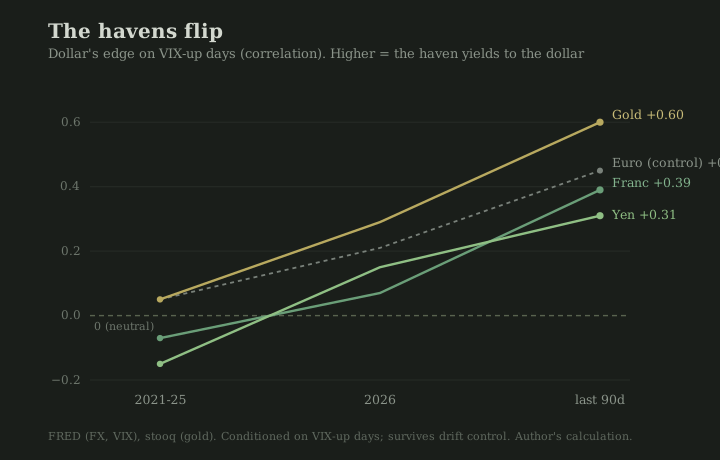
The havens (yen, franc, gold) move to the losing side against the dollar on risk-off days. The euro is the control.
Still, the VIX is low, near 16, and the squeeze is not alight. The sign is pointed at a dollar squeeze; ignition has not arrived.
The rule that separates the two regimes is simple. If the yen is bought in a risk-off, it is a carry unwind; if it is sold, it is a dollar squeeze. Just now it is the latter, which is why the 19-year short is, if anything, supported rather than broken: the backdrop blows fair for the short side. As long as that holds, the first decline sits more easily as voluntary profit-taking. The first warning would be the sign turning over, the day a risk-off starts to buy the yen again.
One tick of the short clock
A paradox sits under all this. The yen short built to a 19-year high because the market expects the deficits to persist. The two trade deficits (energy, and digital and AI services) are both dollar-denominated and price-inelastic; the volumes do not fall much when prices move. It is the source of yen weakness and the ground the short was built on. Structural yen selling is at once the reason for a weaker yen and the hand that wound the squeeze’s spring. The longer the deficit runs, the tighter the spring.
Set against Gyokuro’s three clocks, this is a move on the short clock alone: positioning and the Finance Ministry’s line in the sand. The yen weakness read by the medium clock, the rate gap, and by the long clock, a record-low real effective exchange rate and the structural current account, is untouched. The first decline in a 19-year short is no repudiation of the downtrend. The short clock’s hand has ticked back one notch, no more. The underlying trend and the short-term cover, or squeeze, do not contradict each other.
So which was it? On an orderly tape it still looks like profit-taking. Two things decide the branch. Whether the next CFTC print continues the decline (a top) or widens it again (a reload); and whether spot begins to move on that decline. If it starts to move, the voluntary is turning forced.
The right posture is a plain one: what pulls the trigger is unknown, but if it is pulled the shape is mechanical. What to watch is not the forecast for the rate gap or the memory of August; it is the stress in the plumbing and whether the CFTC keeps declining.
None of this is investment advice or a recommendation to trade.
Related: The three clocks