Few people had heard of the company that went bankrupt on 6 July. Zentoshin, a credit-card settlement agent in Osaka, was no household name. Yet it sat beneath the cash flow of restaurants and the night-time economy across Japan, working as their plumbing. Its liabilities came to about ¥125.9bn (roughly $790m), the largest corporate failure of the year and the first above ¥100bn since Drone Net in December 2025 (TDB, TSR). Its collapse pulled a scatter of regional banks down with it.
The disclosure from Towa Bank is the clearest way in. The Gunma-based second-tier lender said on 7 July that of ¥8bn lent to Zentoshin, ¥5.886bn was unsecured and would be provisioned in the year to March 2027. That is 8.83% of the bank’s net assets, gone to a single counterparty (Nikkei, TSR). But the real story sits outside the number.
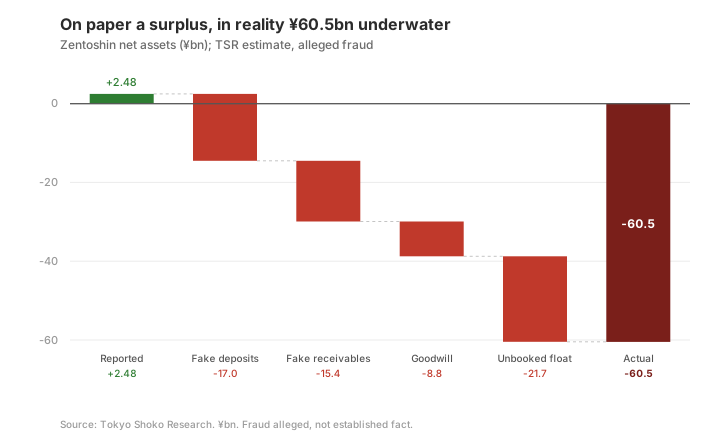
Two days after the bankruptcy, Tokyo Shoko Research (TSR) set out what lay behind it. Zentoshin, it alleges, had dressed up its accounts for at least 20 years to hide deepening losses: inflated deposit balances of about ¥17bn, fictitious receivables of ¥15.4bn, overstated goodwill of ¥8.8bn that was close to worthless and ¥21.7bn owed to merchants that never appeared on the books at all. On paper the firm showed net assets of ¥2.48bn; corrected, TSR says, it was insolvent by some ¥60.5bn (TSR). The largest failure of the year was a hole two decades in the making, finally too big to hide.
Zentoshin advanced merchants the proceeds of their card sales ahead of the card companies, taking a fee for the speed. Because card settlement normally runs weeks behind, that early payment was a lifeline for small firms with thin cash buffers. Its selling point, payouts twice a week and six times a month, drew more than 200,000 merchants by 2018, many of them the snack bars, hostess clubs and cabarets that mainstream acquirers are reluctant to touch. In effect Zentoshin took on the credit of the night-time economy that banks would not face directly: shadow payment infrastructure.
Seen another way, what Zentoshin did was factoring. It turned a merchant’s claim on the card company into cash before it matured. Last month, in “The Cull You Can’t Count”, this column followed the same migration: as banks and promissory notes retreated, small firms’ working capital moved into receivables factoring and revenue-based finance, a lightly regulated corner with no statute of its own. Zentoshin is that structure one layer up, in the payment system. The receivable differs (card takings rather than trade invoices, the night-time economy rather than the workshop), but the function, financing receivables outside the banks, is the same.
So whose money was it? The first instinct misleads. Six regional banks had disclosed ¥19.2bn of loans by 7 July; one might assume the rest was merchant money held in trust. It was not. TDB puts the debt at filing at about ¥115bn and describes it as centred on borrowings from financial institutions (TDB). (The ¥125.9bn cited above is the book figure for the year to March 2025; the ¥115bn is measured at filing, on a different date.) The merchant float, as far as TSR can trace, was about ¥21.7bn and, as noted, off the books. The main creditors were not the merchants but the banks. The six lenders’ ¥19.2bn is the tip of the iceberg.
If TSR’s reading is right, the sequence follows. For 20 years Zentoshin hid its losses, padding the accounts with phantom deposits and receivables while filling the real hole with fresh borrowing. It raised that working capital, nominally to fund early payouts, from regional banks and credit unions with no borrowers at home. Dressed-up accounts looked sound, so the lenders did not question them. The money paid merchants, rolled the old hole and was borrowed again. As long as it kept flowing, it could run for two decades. What stopped it was the criminal case of 2024. Once a firm entrusted with payments is referred to prosecutors under the organised-crime law, lenders and card companies step back. With new borrowing choked, fabricated books cannot fill a real gap. Zentoshin filed for bankruptcy itself. Nobody pulled the trigger from outside; the company, out of room, pulled its own.
That case dates from two years before the collapse. In January 2024 employees were arrested for signing up restaurants that could not pass the usual card-acquiring checks, using other people’s names; a Tokyo sales chief was held on suspicion of falsifying private electromagnetic records, and the company was later referred to prosecutors on suspicion of breaching the organised-crime law. Referral is neither indictment nor conviction, and the person arrested was not the chief executive. But the charge, lending merchant names so that a Shimbashi clip joint could take cards, lights up from another angle the kind of credit this firm carried.
That the banks dominate the debt does not spare the merchants. The ¥21.7bn owed to them was never booked, and their takings were commingled with Zentoshin’s own money rather than held separately. In bankruptcy that money ranks as an ordinary claim, with no collateral and no priority; recovery will be a fraction, paid out over time. And it is money already spent: merchants ran on the fast payout, meeting rent and stock before it arrived, so a stopped payment can drain the cash of a profitable business. The Japan Food Business Association issued an emergency notice on the day of the filing, urging members to stop using the terminals, tally what was owed and arrange other means, and is pressing for safety-net loans and guarantees (JFBA). As of 8 July the Small and Medium Enterprise Agency had not designated Zentoshin for the guarantee (TSR). The second wave of the cull is simply not yet counted.
Below the waterline are lenders not yet visible. Line up the six that disclosed by 7 July and the shape appears: Towa in Gunma at ¥8bn, Sanjusan in Mie at ¥5bn, Kirayaka in Yamagata (through Jimoto Holdings) at ¥2.7bn, Taiko in Niigata at ¥1.5bn, Kochi at ¥1.2bn, Shimane at ¥0.8bn (TSR, Jiji). These six were all out-of-area, not one an Osaka bank. But the fuller list TSR drew from the filing on 9 July is larger, and led by a local name. Of ¥115.2bn filed, 63 financial creditors are owed ¥113bn, and the biggest single claim, about ¥21.9bn, is Kinki Sangyo, an Osaka credit cooperative (which put its own loans at ¥12.456bn, 6% of net assets, and expects to stay profitable after provisioning) (Nikkei). Behind it come Tokyo Star at ¥8bn, Yamaguchi at ¥7.5bn (secured, no cost), Osaka’s Kosei credit union and out-of-area names such as Tokyo’s Daiichi-Kangyo cooperative and Shizuoka. Even a revenue-based crowdfunding lender, Bankers, is on the list at ¥2.1bn, its retail investors now exposed. The Financial Services Agency has begun a survey extending to credit unions and cooperatives (Nikkei). Borrowings are almost the whole of the debt; the six were only the tip.
The pattern is not chance. As the Bank of Japan normalises policy, a problem the regional banks have carried for years is surfacing: shrinking home markets push weaker lenders into out-of-area, out-of-sector credit they cannot properly judge. Zentoshin was where that pressure showed at its worst. Twenty years of fabricated accounts, on TSR’s telling, went unnoticed by auditors and lending banks alike, or unquestioned, the yield taking precedence. The fraud explains why the accounts looked sound; it does not explain why banks with no borrower at home were reaching into the night-time economy in the first place. That choice was their own. Towa’s bet of 8.83% of net assets on a single Osaka nightlife-payment firm is the emblem. The bank has not explained why it held the exposure. But six banks burnt by the same borrower point to a pressure common to regional banking, not six separate lapses of judgement. Towa’s shares turned down on the afternoon of 7 July and closed 8.5% lower at ¥1,401 (Bloomberg, 7 July). The market did not take it lightly.
“The Cull You Can’t Count” argued that the winnowing of small firms after the pandemic runs on without showing up in the statistics. This is the reverse. Here the hidden layer surfaced all at once. Credit that was not merely missed by the data but, it seems, buried in the accounts for 20 years now showed up as figures on named banks’ balance sheets, Towa’s ¥5.886bn and Sanjusan’s ¥2.7bn, and in an insolvency of some ¥60.5bn. When one settlement agent stops, the cash flow of 200,000 merchants and the earnings of six regional banks are cut at once. What could not be seen is suddenly legible, in the right order of magnitude.
For investors the implication is narrow but pointed. There is one more reason not to turn bullish on the regional-bank sector. Normalisation lifts their margins, true, and that is the bull case. But the same normalisation is peeling back the risky out-of-area credit that propped those margins up. Zentoshin showed what waits underneath: a hidden hole and the regional-bank money that filled it.
(This piece is not investment advice. The alleged accounting fraud and insolvency are TSR’s findings at this stage and not established fact. Figures draw on the banks’ own disclosures and reporting by TDB, TSR, the Nikkei and Jiji; the composition and size of the liabilities may change as the bankruptcy proceeds.)