On 25 March, this blog argued that Katayama Satsuki could not intervene in the yen market until three political gates opened. The budget was hostage to a hostile upper house. The yen sat at 158.9. Katayama’s verbal escalation – three warnings in March alone – had no ammunition behind it.
Two weeks later, the picture has changed.
The budget gate
The ¥122.3 trillion budget passed the upper house on 7 April, six days after the fiscal year began and eleven years since a Japanese budget last missed the 1 April deadline. The margin was as thin as it gets: a tied committee vote broken by Chairman Fujikawa’s casting ballot.
None of that matters now. The budget is law. Katayama is no longer hostage to opposition leverage over spending bills. She can act without handing ammunition to parties that might tie intervention to budget concessions.
The passage also unlocked the FY2026 reserve fund. In her press conference the same evening, Takaichi stated the government would “take all necessary measures without hesitation.” The fiscal apparatus is loaded.
The Washington gate
The September 2025 Katayama-Bessent joint statement remains the operating framework. It permits intervention against “excess volatility and disorderly movements” not reflecting fundamentals. Katayama has cited this statement repeatedly (November, December, January, March), each time emphasising that Japan has a “free hand.”
What changed is Bessent’s own position. The FOMC minutes released on 8 April revealed a dovish tilt: several policymakers acknowledged rate cuts could become appropriate later in 2026. The dollar erased its year-to-date gains; DXY fell to 99.0. A weaker dollar is the one environment in which Washington is least likely to object to yen-buying intervention. Bessent, who sits in the Situation Room managing the Iran crisis and its oil price consequences, has every incentive to let Japan absorb some of the dollar selling for him.
The January rate check (widely reported at the time as the New York Fed verifying USD/JPY levels with dealers) confirmed the infrastructure is live and the precedent set. It does not guarantee acquiescence for actual intervention, but it narrows the gap between words and action.
The BOJ gate
Here the picture is more conditional, but the direction is clear. The Bank of Japan held rates at 0.75% in March by an 8-1 vote, with Takata dissenting in favour of hiking to 1.0%. Since that meeting, the data have moved in the hawks’ direction.
OIS pricing from Totan ICAP puts the 28 April hike probability at 58%, with the market pricing one hike as near-certain and a second as a coin flip by October (as of 9 April). Bloomberg polls are higher, at roughly 70%. Former BOJ executive director Kaizuka and former chief economist Sekine have both publicly stated that an April move would be appropriate. Ueda told parliament on 9 April that real interest rates remain “clearly negative” and that accommodative conditions are being “maintained” – language that emphasises how far the BOJ remains from neutral, not how close it is to pausing.
A hike to 1.0% would narrow the UST-JGB policy rate spread from 275 to 250 basis points. On 10-year bonds, the spread has already compressed to 190 basis points, through the 200 basis point level that historically precedes carry unwind pressure. Both legs are now moving against carry at once: JGB yields rising (funding cost up) and UST yields falling (carry return shrinking). JGB 10-year hit +4.0σ on 9 April, a crisis-grade velocity move driven by hike repricing, not auction failure. The 5-year auction the same day posted a bid-to-cover of 3.58, confirming adequate demand.
If the BOJ hikes on 28 April, Katayama gets her third gate. Intervention following a rate hike is far more credible than intervention against an unchanged rate; the market reads it as policy alignment rather than a lone MOF gambit. The July 2024 intervention succeeded partly because it came alongside BOJ tightening expectations. The same sequencing is available now. A hike alone could suffice: the December hike and the January rate check together pushed USD/JPY to 152, and this time the FOMC is softening the other leg of the spread. Intervention is insurance for the scenario where the dollar does not cooperate, Hormuz stays closed and oil re-spikes.
Katayama’s gates are not a prediction that she will intervene. They are a map of the conditions under which she can.
The ceasefire that was not
The gate opening would matter less if the yen were strengthening on its own. It is not.
Trump’s two-week ceasefire with Iran, announced 7 April, triggered the largest single-day oil price drop since April 2020. By the next morning it was unravelling: Israel struck Lebanon, the IRGC halted Hormuz shipping, Hezbollah fired rockets at Israel. As of 9 April, over 400 tankers remained anchored in the Persian Gulf. Oil bounced back to $98.
The market bought a headline. Japan still imports over 90% of its crude from the Middle East. The Strait of Hormuz is still functionally closed. Alternative procurement, as Takaichi detailed in her press conference, will cover only about half of normal imports by May. The yen remains under energy-driven selling pressure that has nothing to do with speculation.
The damage is already showing up on the ground. The Cabinet Office’s Economy Watchers Survey polls taxi drivers, shop owners and restaurant managers: people who feel the economy before statisticians measure it. The March reading, released 8 April, dropped to 42.2 from 48.9 in February: a 6.7-point plunge to a 49-month low, far below the consensus forecast of 48.0. The outlook index fell even harder, to 38.7 from 50.0, the lowest since December 2020.
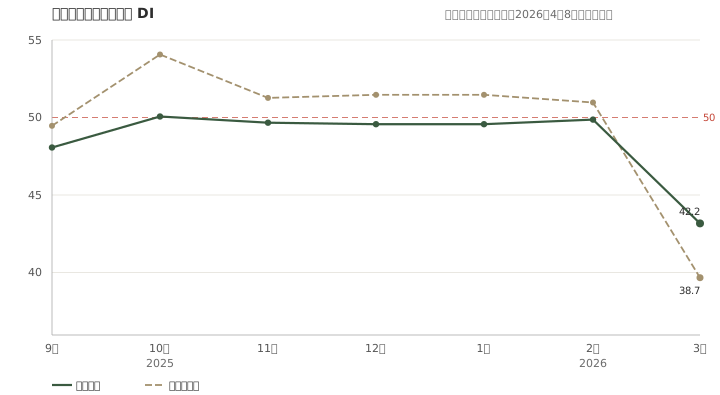
A reading below 50 signals contraction; 42 signals that the oil shock is no longer an abstraction in bond markets but a lived reality in household budgets. That reality gives Katayama something her verbal escalation lacked: political cover. The same data complicates the BOJ’s calculus: the inflation case for hiking is strengthened by the oil shock, but the growth case is weakened by collapsing consumer sentiment. Which lens the board applies on 28 April will determine whether Katayama’s third gate opens.
The convergence window
Three catalysts now sit within three weeks of one another.
Oil-driven yen weakness is fundamental, not speculative, which makes intervention harder to justify under the Katayama-Bessent joint statement. But the CFTC report on 11 April will show whether ceasefire-week positioning has shifted. Leveraged fund yen shorts are light; if the ceasefire unwinds and USD/JPY pushes back toward 160, speculative positioning will rebuild and the speed of the move will give Katayama the “disorderly and excessive” language she needs. The Iran sanctions waiver expires on 19 April; Bessent has used each extension to cap oil prices preemptively, and letting it lapse while Hormuz remains closed would push Brent well above $100.
The BOJ meets on 27-28 April. If the hike comes and Katayama intervenes in the same week, the combination would hit carry traders on three fronts at once: higher Japanese rates, lower US rates and a direct yen bid from $1.18 trillion in deployable foreign currency reserves. In 2024, Japan spent ¥9.8 trillion ($62 billion) on intervention across April-July and USD/JPY fell from 162 to 149 in the three weeks following the July operation, eventually reaching 142 by mid-September. The reserves are deeper now. The political conditions are at least as favourable.
The BOJ could still delay, citing geopolitical uncertainty, and without that third gate the window stays shut. But for the first time since Katayama took office, all three can be open at once, and carry traders face a deteriorating risk-reward regardless. The spread compression to 190 basis points is already eating into returns, and a BOJ hike would compress it further. Intervention would trigger stop-losses and forced covering in a market that is directionally short yen but not yet at extreme positioning, which means the move has room to run before exhaustion.
The question is where it stops. The March Tankan survey shows corporate Japan budgeting for USD/JPY at 150 in the first half of FY2026. Toyota’s assumption, as of its November forecast, is 146; the company estimates that each yen of appreciation costs roughly ¥50 billion in annual operating profit. A correction from 159 to the 150-155 range (a 3-5% move) is tolerable for all parties: it eases import costs without triggering export earnings downgrades, and gives the MOF reason to withdraw. Below 145, the calculus inverts. Earnings downgrades cascade through autos, electronics and machinery, the Nikkei reprices, and the intervention that was meant to stabilise the economy begins to destabilise it.
The intervention trigger is 160. The target is around 150. The risk is overshooting to 142, where the cure becomes worse than the disease. For equity investors, the implication is that a controlled yen correction is the best of the available outcomes: it removes the tail risk of a ¥170 blowout that forces emergency tightening, at the cost of a temporary hit to exporter earnings that is already priced into the Tankan outlook.
The date to watch is 28 April. If Katayama moves, she will move around the BOJ decision, not before it. The budget gate is open. The Washington gate is ajar. The BOJ gate decides whether she walks through. USD/JPY is 70 pips from 160. At this pace, Katayama may not have to decide. The market will decide for her.